
A village and its castle
Champoly is one of the smallest communes of the Pays d'Urfé, a scatter of houses, farms and hamlets on the slopes of the hills between Saint-Just-en-Chevalet and the higher forests. What gives it a place on every map of the area is the hill that rises above it, crowned by the two grey towers of the Château d'Urfé. The ruins stand within the commune, and the village is the natural starting point for anyone heading up to them.
For centuries Champoly lived in the castle's shadow in a literal sense. Its inhabitants farmed the land around the hill, paid dues to the lords above and saw the fortress gradually emptied after the Urfé family moved to the plain. Today the relationship is gentler: the ruins draw walkers and visitors, and the village is a quiet place where life follows the rhythm of farms and seasons.
The church and the memorial
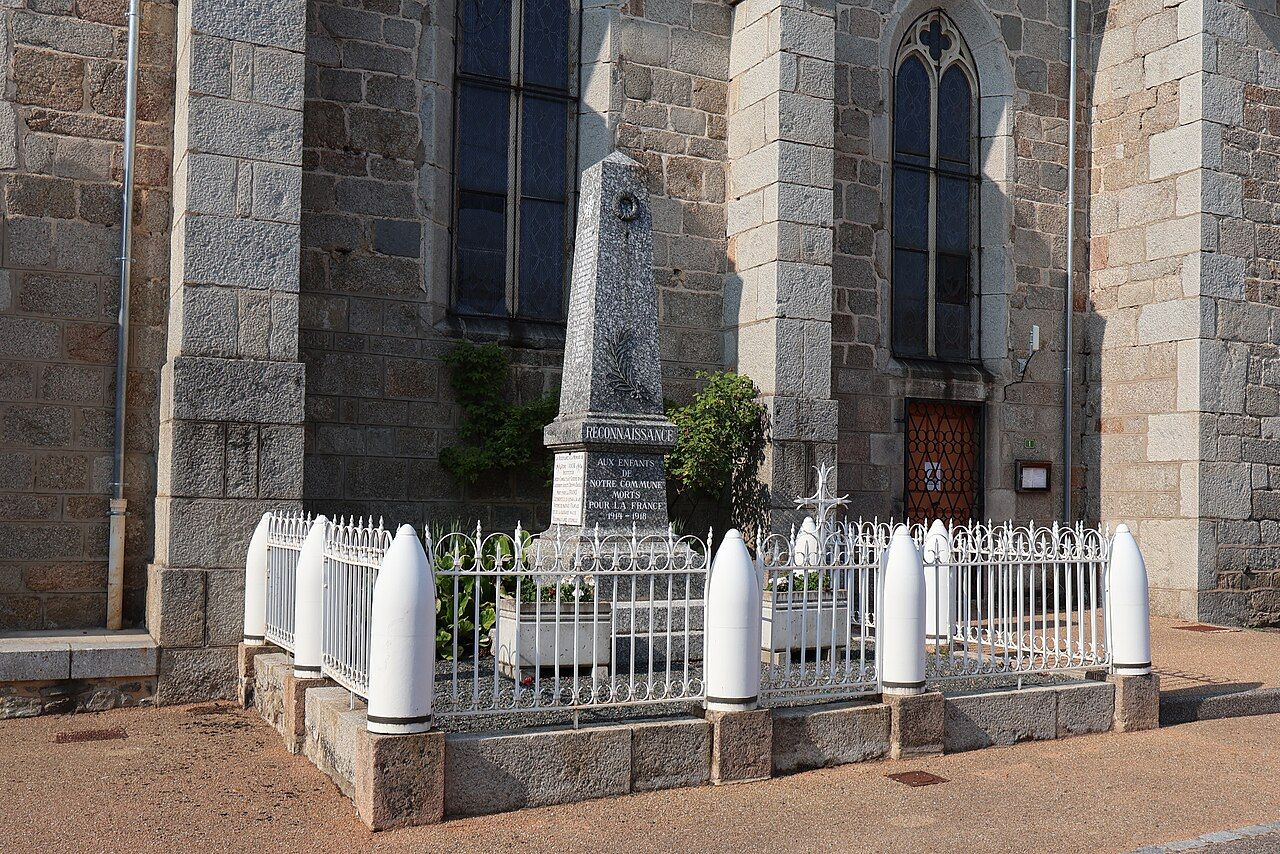
At the centre of the village stands the parish church, built of grey granite blocks with tall pointed windows and solid buttresses. Its style is plain and sturdy, in keeping with the materials of the hills, and its bell tower is a landmark from the surrounding lanes.
Against the church wall stands the war memorial, a granite obelisk on a square base, surrounded by a low white railing with shell-shaped posts at its corners. Its inscription honours the men of the commune who died for France, and the list of names is a sobering reminder of how much a small rural community gave in the wars of the twentieth century. Many villages of the Loire hills lost a large share of their young men, and the memorials, often placed beside the church, are among the most moving monuments of the area.
Take a moment here before heading up the hill. The church square is quiet, and on a warm day the granite holds the sun long after the light has moved on.
Paths up the hill
From the village, lanes and footpaths lead up towards the castle through fields, hedges and patches of woodland. The climb is steady rather than steep, and the reward at the top is one of the widest views in the Loire hills, from the forests of the north to the Forez plain and the Monts du Lyonnais.
Turn the page: Saint-Romain-d'Urfé, a name on the signpostsWalkers can choose between the direct approach, which follows the road towards the parking area below the ruins and then a short path to the summit, and longer loops that circle the hill and come back by another route. Several of the area's signed walking circuits pass through or near Champoly, and local maps show their routes.
- The direct climb. Village to castle by lanes and path, a good outing of a couple of hours there and back.
- A loop round the hill. Woods and meadows on the slopes, with the castle in view from different sides.
- Linking villages. Paths continue towards Saint-Romain-d'Urfé and Saint-Just-en-Chevalet for a longer day.
Paths can be muddy after rain and slippery in autumn leaves. Good shoes help, and in summer bring water, as there are no facilities on the hilltop.
The landscape around Champoly
The countryside around the village is typical of the Pays d'Urfé: small fields bordered by hedges, pastures with grazing cattle, woods of beech, oak and fir, and granite farmhouses with steep roofs and wide barn doors. Streams run down the slopes in small valleys, and the lanes between hamlets follow the contours in long curves.
Higher up, the woods thicken into the dark fir forests that cover the hills to the north and west. These forests are part of the same upland as the Bois Noirs, and walkers who continue beyond the castle hill soon find themselves among tall trees, moss and quiet tracks.
The farms of the area still shape the landscape. Hay meadows are cut in early summer, cattle move between pastures, and in autumn the woods fill with the colours of turning leaves. Stone crosses at crossroads and old bread ovens beside farmhouses tell of a rural life that has changed a great deal but left its marks everywhere.
When to visit
Late spring and early autumn are the best seasons for Champoly and its castle. In May and June the meadows are full of flowers and the woods a fresh green. In September and October the light is clear, the beeches turn copper and the views from the summit are often at their sharpest.
Summer is pleasant too, with long evenings and warm days, though haze can soften the views. Winter brings occasional snow to the hills, which can make the upper roads difficult; check conditions before driving up, and remember that the summit is exposed to wind in any season.
Practical notes
Champoly is a small village with very limited services. Bring what you need for the day, or plan to stop in Saint-Just-en-Chevalet, a short drive away, for supplies. Parking in the village is limited, so leave your car considerately and avoid blocking farm entrances or narrow lanes.
The village is best reached by car along small departmental roads. Once here, the castle hill is close enough to walk, and the lanes around the village make pleasant short outings even if you do not go to the top.
Champoly asks little of its visitors beyond a slow pace and respect for its quiet. In return it offers one of the most direct ways into the history of the Pays d'Urfé, from the war memorial by the church to the ruined towers on the hill above.