
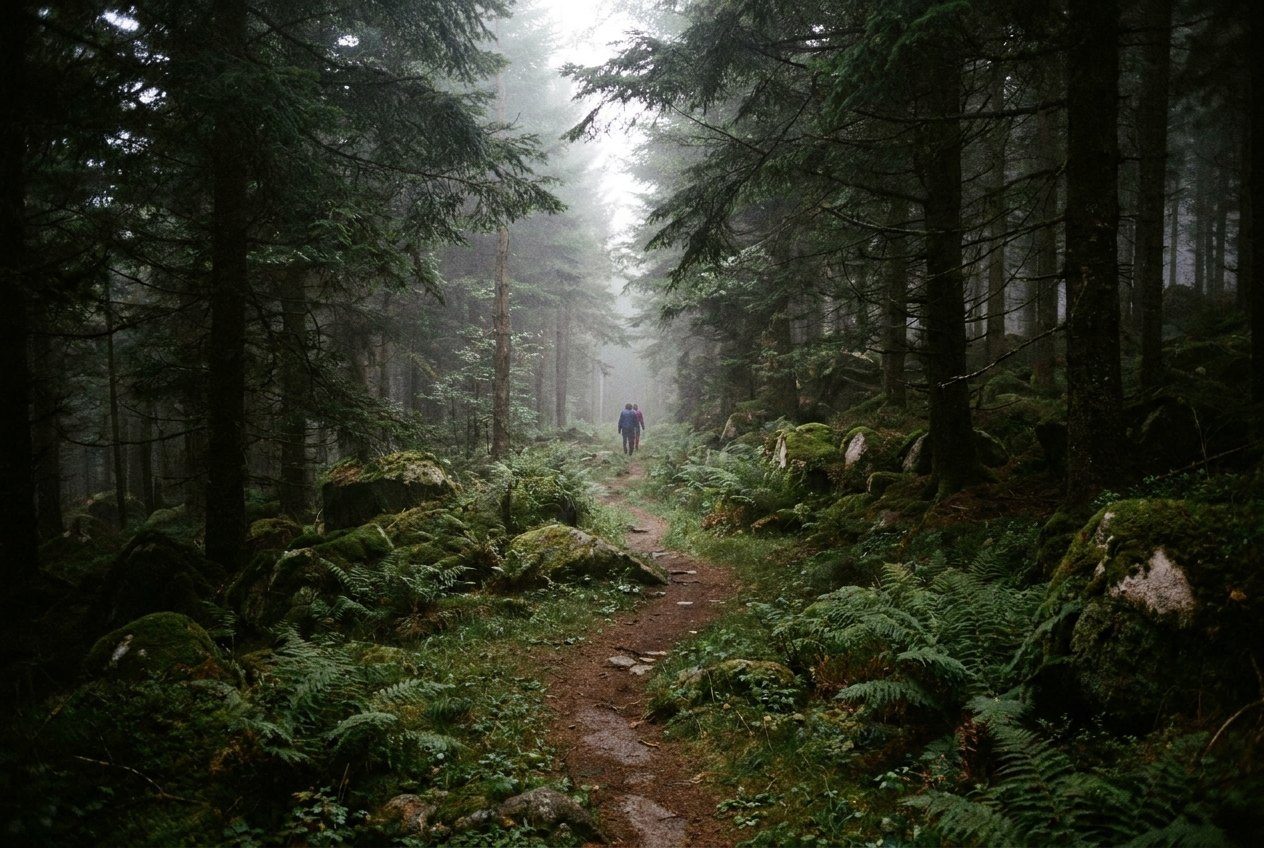
The black woods
The Bois Noirs, the black woods, cover a wide upland on the north-western edge of the Loire département, spilling over into the Allier and the Puy-de-Dôme. The name comes from the forest itself: dense stands of silver fir and spruce that look almost black from a distance, especially under a grey sky. For anyone travelling up from the green valleys of the Pays d'Urfé, the change is striking. The pastures thin out, the roads begin to wind through tall trees, and the light turns dim and green.
The massif rises to around 1,290 metres at the Puy de Montoncel, close to the point where the three départements meet and often described as the highest point of the Allier. Most of the forest lies between about 800 and 1,200 metres, on rounded ridges and slopes cut by small stream valleys. To the east, the Bois Noirs merge into the Monts de la Madeleine; to the south, they look down on the villages of the Pays d'Urfé.
The ground beneath the forest is granite, an old crystalline rock that weathers into acid, sandy soils. These soils suit conifers, and the silver fir has grown naturally on these heights for a very long time, often mixed with beech. Over the last century and more, plantations of spruce and other conifers have been added, so the forest today is a mosaic of old mixed woods and younger planted blocks.
Walking through it, you notice the changes. In the older stands, tall firs and beeches rise from a floor of moss, ferns and bilberry, with fallen trunks slowly rotting into the soil. In the planted blocks, the trees stand in straight rows and the ground beneath them is dark and bare. Clearings, where timber has been felled, open sudden views and fill with foxgloves, raspberries and young trees.
Forestry is still a living activity here. Logging tracks cross the woods, timber stacks wait by the roads, and in some seasons you may hear machines at work. Respect any signs closing paths during felling, and keep well away from working areas.
Peat bogs and springs
Scattered through the forest are peat bogs and wet meadows, where water collects on the granite and slowly builds up layers of moss and plant remains. These bogs are among the most fragile and interesting habitats of the Loire hills. Sphagnum mosses, cotton grasses and small specialised plants grow here, and some bogs are known for carnivorous plants such as sundews, which trap tiny insects on sticky leaves.
The bogs and springs feed the streams that run off the massif in every direction. A walk in the forest often follows one of these young watercourses, clear and cold over stones, down a narrow valley. In spring and after heavy rain, the sound of running water is everywhere.
The bogs are easily damaged. Their surface may look solid but is often a floating mat of moss over water, and footprints can leave marks that last for years. Admire them from the edge or from any boardwalks provided, and never walk across them.
Turn the page: Saint-Romain-d'Urfé, a name on the signpostsThe ridge between two rivers
The Bois Noirs straddle one of the important watersheds of central France. Rain falling on the eastern slopes runs towards the Loire, while rain falling to the west drains into the Allier. The two great rivers meet much further north, near Nevers, but here on the ridge their waters part within a few hundred metres of each other.
It is hard to see the watershed on the ground, as the ridges are broad and wooded. Maps make it clearer, and some walking routes follow the high ground along the divide. On a clear day, from the few open viewpoints, you can look one way towards the Loire valley and the other towards the Allier and the volcanic hills of Auvergne.
The forest is a place where silence carries meaning. Few roads cross it, villages are scattered, and on a weekday you can walk for hours without meeting anyone. That isolation is part of its appeal, but it also calls for care.
The forest is a place where silence carries meaning.
Wildlife of the forest
The Bois Noirs shelter a range of wildlife typical of the uplands of central France. Roe deer move through the clearings at dawn and dusk, wild boar leave rooted-up ground along the paths, and foxes and badgers live in the quieter woods. Red squirrels are common among the conifers, and the forest birds include woodpeckers, among them the large black woodpecker, whose loud call carries far through the trees. Crossbills feed on cones in the tops of the firs, and birds of prey hunt over the clearings.
Patience and quiet are the keys to seeing them. Walk slowly, stop often, and be out early in the morning or late in the evening when animals are most active. Binoculars help. Keep dogs on a lead, both to protect wildlife and because the forest is used for hunting in season.
Mushrooms in season, and the rules
Autumn brings mushroom seekers to the Bois Noirs, as to many forests of the Loire hills. Ceps and other edible species grow under the firs and beeches after warm rain in late summer and autumn, and local people have long gathered them.
Picking is not a free-for-all. In France, mushrooms belong to the owner of the land, and the forests here are a mix of public and private property. In public forests, picking small quantities for personal use is generally tolerated, but local rules may limit quantities, days or areas, and some private forests forbid picking altogether. Rules change and vary from commune to commune.
- Know your species. Some deadly mushrooms resemble edible ones. Never eat anything you cannot identify with certainty; some pharmacists in France can help check a basket.
- Pick gently. Cut or twist mushrooms carefully, leave small ones, and use a basket rather than a plastic bag.
- Respect the hunt. Autumn is also hunting season. Look for signs announcing hunts, wear bright clothing, and avoid the woods on hunting days if you can.
More on the season, its colours and its customs, is in our guide to autumn colours and mushrooms.
Walking in the Bois Noirs
The forest is crossed by forest roads, logging tracks and footpaths, some of them part of the area's waymarked walking circuits. Villages such as Saint-Priest-la-Prugne make good starting points, and a few circuits climb to the high ground near the borders of the three départements.
The Bois Noirs can be disorientating. Junctions look alike, tracks multiply, and fog sometimes drifts in without warning. Carry a good map and know how to use it, as phone signal is unreliable in places. Tell someone your route, carry warm layers and a waterproof even in summer, and allow plenty of time. In winter, snow can cover the forest for weeks, turning it into country for snowshoes rather than boots.
The reward for that care is a forest unlike any other in the Loire département: dark, quiet and wild, with the scent of resin in the air and the sound of water never far away.