
A village with a family name
Several communes in this part of the Loire carry the name of Urfé, and Saint-Romain-d'Urfé is one of them. The name links the village to the lords whose castle still stands in ruins on a hill not far away, above Champoly. For centuries the land around Saint-Romain belonged to the Urfé domain, and the family's name stuck to the parish long after the lords had moved down to the Forez plain and their line had died out.
Today Saint-Romain-d'Urfé is a small upland village, home to a few hundred people in its bourg and the hamlets around it. It lies among fields and woods in the heart of the Pays d'Urfé, a short drive from Saint-Just-en-Chevalet and within reach of the forests to the north and west.
The main street
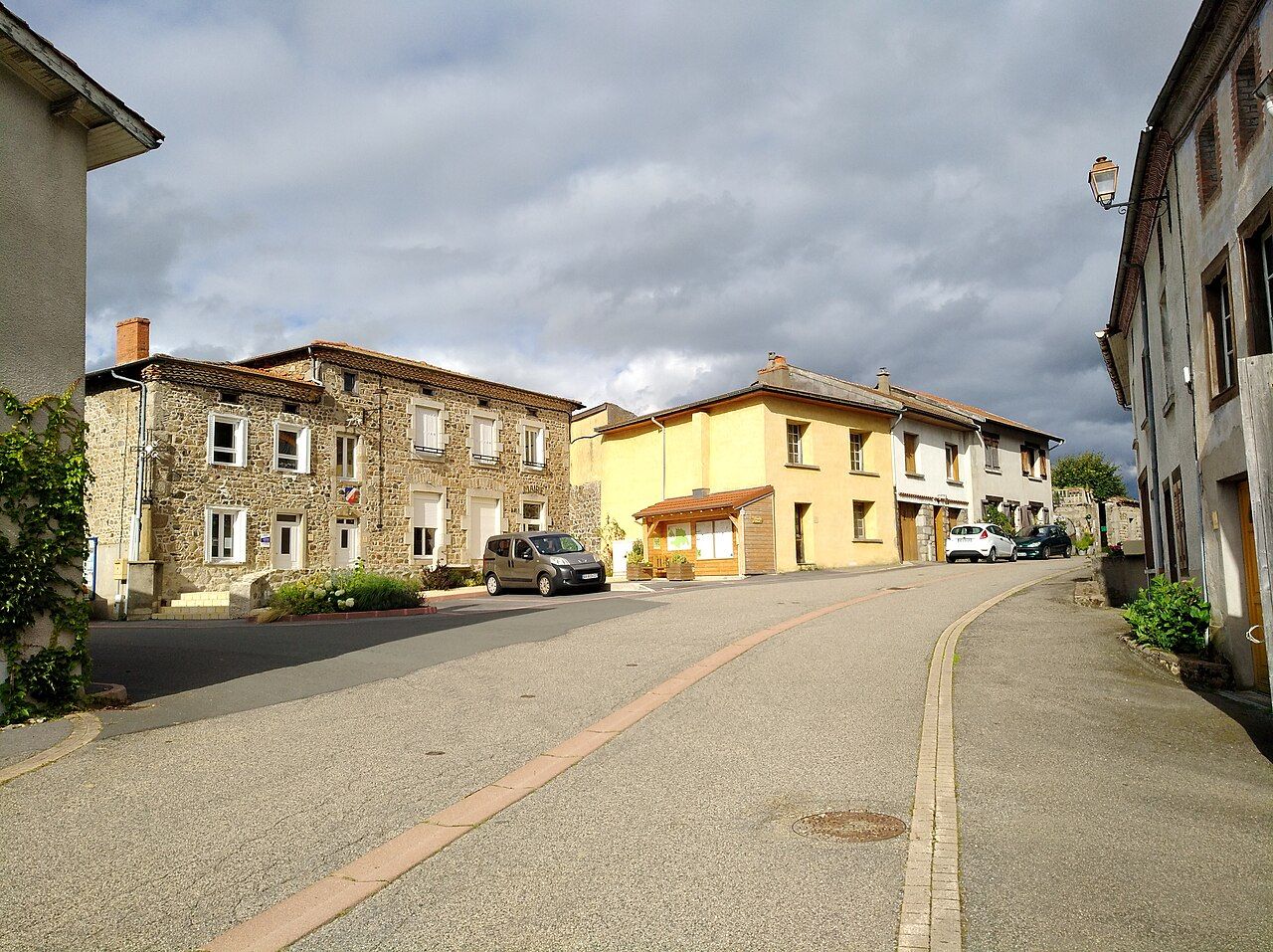
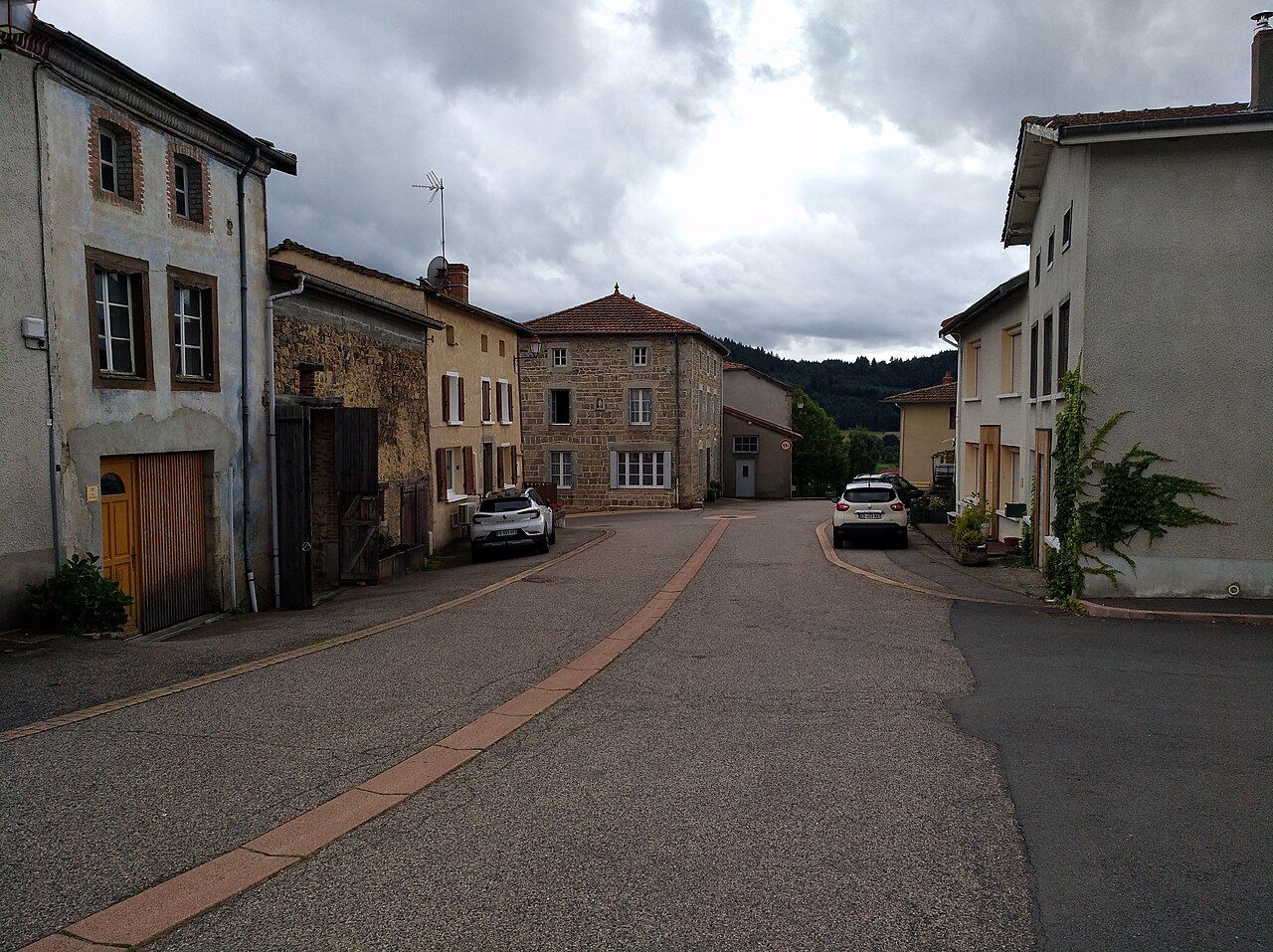
The village grew along its main street, a departmental road that climbs gently between houses of stone and render. Some of the buildings are solid granite houses with rows of shuttered windows, others are rendered in yellow or cream, with wooden doors and small gardens in front. Street lamps hang from wall brackets, and at a bend the road opens into a small square where the main buildings stand.
Walking the length of the street takes only a few minutes, but it is worth doing slowly. Look at the stonework of the older houses, where rough granite blocks are set with dressed stone around doors and windows, and at the barns and outbuildings tucked behind them. Beyond the last houses the road leaves the village between pastures, and the dark line of the woods rises on the slopes ahead.
Under a heavy sky, which is common here, the street can look stern, all grey stone and shuttered windows. When the sun breaks through, the colours change at once: the granite turns warm and golden, the yellow render glows, and the hills behind the roofs show every shade of green. Visit on a day of changing weather and you may see both moods within an hour.
The mairie and the square
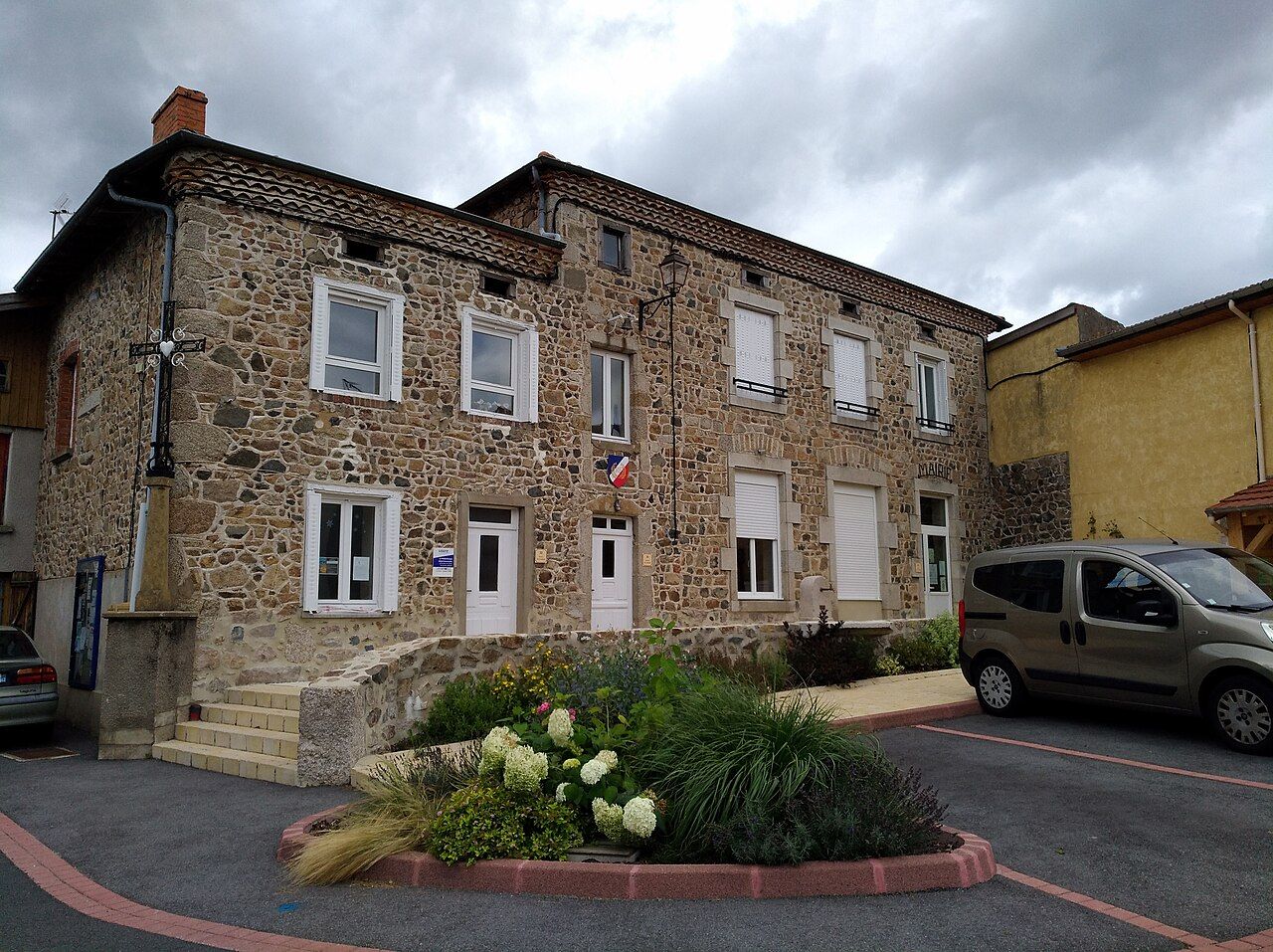
The mairie is one of the most handsome buildings in the village, a two-storey house of rough stone with white windows and doors, a tricolour shield above the entrance and a garden bed of flowers in front. A wrought-iron cross on a stone pillar stands at its corner, the kind of wayside cross found at so many junctions in the Loire hills.
The parish church stands nearby, as in most villages of the area, at the centre of community life. Like its neighbours, it is built of local stone and reflects centuries of alteration and repair. Its doors are not always open; if you find it closed, the mairie may be able to tell you when it is accessible.
Turn the page: Champoly, in the shadow of the towersFarms and pastures
The countryside around Saint-Romain-d'Urfé is farming country. Cattle graze the steep pastures, hay meadows are cut in early summer, and small fields bordered by hedges and stone walls cover the lower slopes. Granite farmhouses with wide barn doors sit in their hamlets, some still working, others converted or quiet.
This is the landscape described in our guide to granite farms and stone crosses: steep roofs, thick walls, bread ovens beside the houses and crosses at the crossroads. Driving or walking the lanes around the village, you will find plenty of examples. Remember that farms are private and working places; admire them from the road and close any gates you pass through. On narrow lanes, give way to tractors and livestock, and expect to meet a herd being moved between fields at any time of day.
Into the woods
Above the village, the farmland gives way to woods of beech, oak and fir. These forests climb towards the higher hills of the Pays d'Urfé and the dark upland of the Bois Noirs. Forest tracks and paths lead into them, and walkers can spend hours among the trees, following streams, crossing clearings and climbing to viewpoints.
Several of the area's signed walking circuits pass through or near Saint-Romain-d'Urfé. They combine village lanes, farm tracks and forest paths, and some link with the routes around Champoly and the castle hill. Maps of the circuits can usually be found locally.
- Short loops. Lanes around the village make easy walks of an hour or two.
- Forest walks. Paths into the woods give shade in summer and colour in autumn.
- Towards the castle. Longer routes lead to the Château d'Urfé above Champoly.
Seasons and practical notes
Spring and early summer bring flowers to the meadows and fresh green to the woods. Autumn turns the beeches gold and copper and brings mushroom seekers to the forest; picking rules vary. Winter can be cold, with snow on the higher ground, and the roads may be slippery.
Saint-Romain-d'Urfé is reached by departmental roads from Saint-Just-en-Chevalet and the surrounding villages. A car is the practical way to get around, as public transport is limited. Services in the village are few, so bring supplies for the day or stop in Saint-Just on the way. Parking is limited; leave your car where it does not block farm access or narrow lanes.
The village asks for nothing more than an unhurried visit. Walk the main street, look at the stonework, read the name on the signpost and remember the family that gave it, then head up into the woods where the lords of Urfé once hunted.