
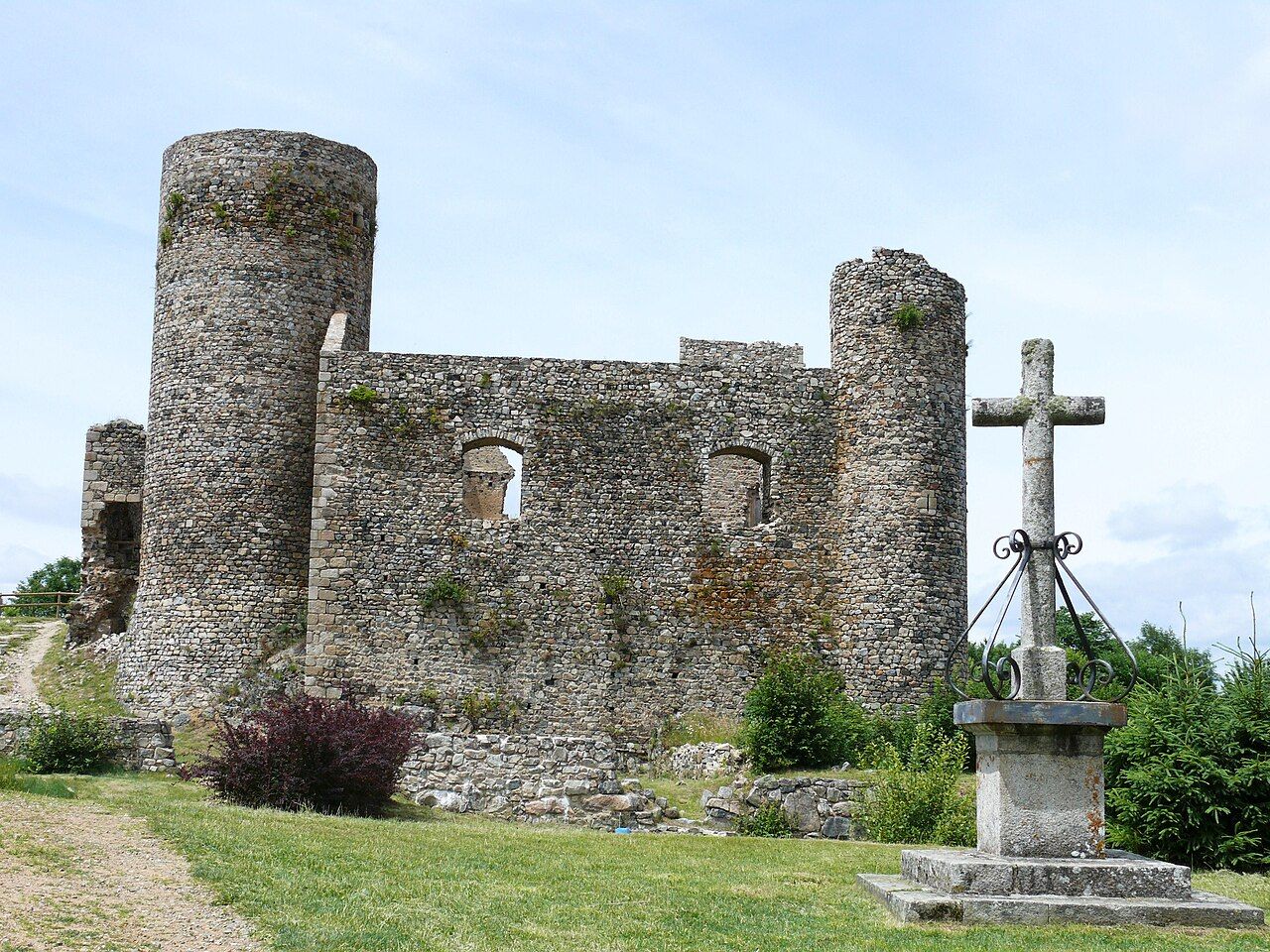
A ruin you see from far off
Drive the small roads of the Pays d'Urfé for half a day and sooner or later a pair of grey towers shows on a wooded summit, one round and one square, standing out against the sky. This is the Château d'Urfé, the old stronghold of the family that gave its name to the whole area. Local people often call it the Cornes d'Urfé, the horns of Urfé, because from a distance the two towers rise from the hill like a pair of horns.
The ruins stand in the commune of Champoly at a little over 900 metres, on one of the high points that close off the Forez to the north-west. The site is open hillside around a broken shell of walls, so a visit is less about rooms and furniture than about stone, wind and distance. You come for the climb, for the feeling of a medieval lookout, and above all for the view that opens on every side once you reach the top.
The family and the hill
The Urfé lords were a local family who rose over several centuries into the circle of the dukes of Bourbon and later the kings of France. Their first fortress here is thought to date from around the twelfth century, and it grew in stages through the later Middle Ages, with a curtain wall, a courtyard, the tall square Tour Haute and the round keep that now dominates the summit.
By the fifteenth and sixteenth centuries the family's ambitions lay elsewhere. They moved down to the Forez plain, where the old manor at Saint-Étienne-le-Molard was rebuilt as the Renaissance Bâtie d'Urfé. The hilltop castle was gradually left behind, and like many abandoned fortresses it slowly lost its roofs, floors and dressed stone. The best-known member of the family, Honoré d'Urfé, wrote the long pastoral novel L'Astrée, which carried the name of this corner of the Loire into the libraries of seventeenth-century Europe.
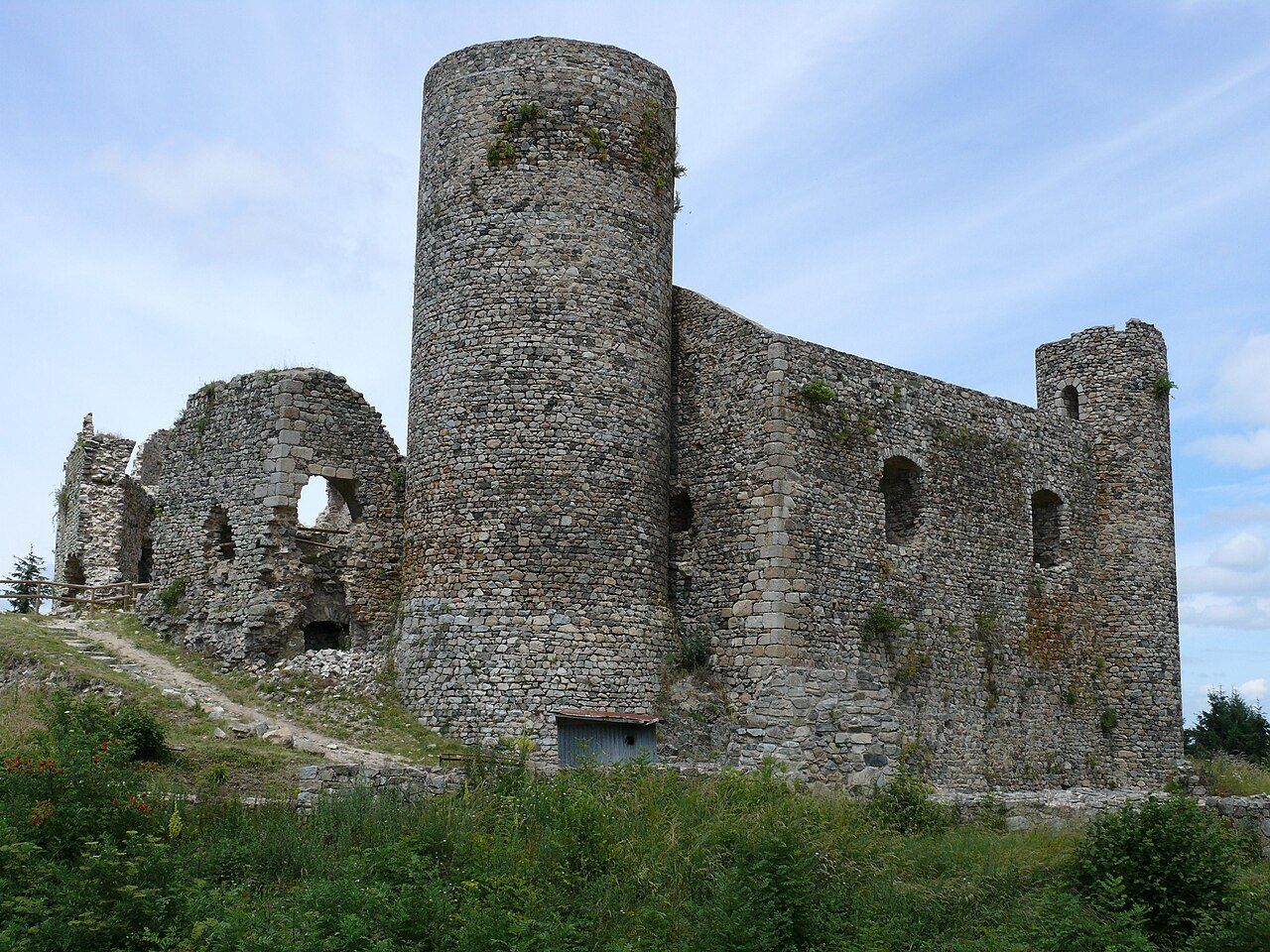
The castle was never a palace; it was a lookout with walls, and the lookout is what survives. In recent decades conservation work has consolidated the walls so that visitors can walk among them again, and the round keep has been made safe enough to climb, which turns the ruin into a viewing platform.
The castle was never a palace; it was a lookout with walls, and the lookout is what survives.
Getting up there
Most people approach from the village of Champoly, below the hill. A narrow road climbs through fields and woods towards the summit and ends at a parking area some way below the ruins; from there a short path goes up through grass and trees to the walls. The last stretch is steady rather than steep, and most walkers manage it in a quarter of an hour or so.
If you prefer to arrive on foot, several of the area's waymarked circuits pass close to the castle hill, and a loop from Champoly makes a good half-day with the ruins as its high point. Paths can be muddy after rain, and in winter the upper road may be icy or closed by snow.
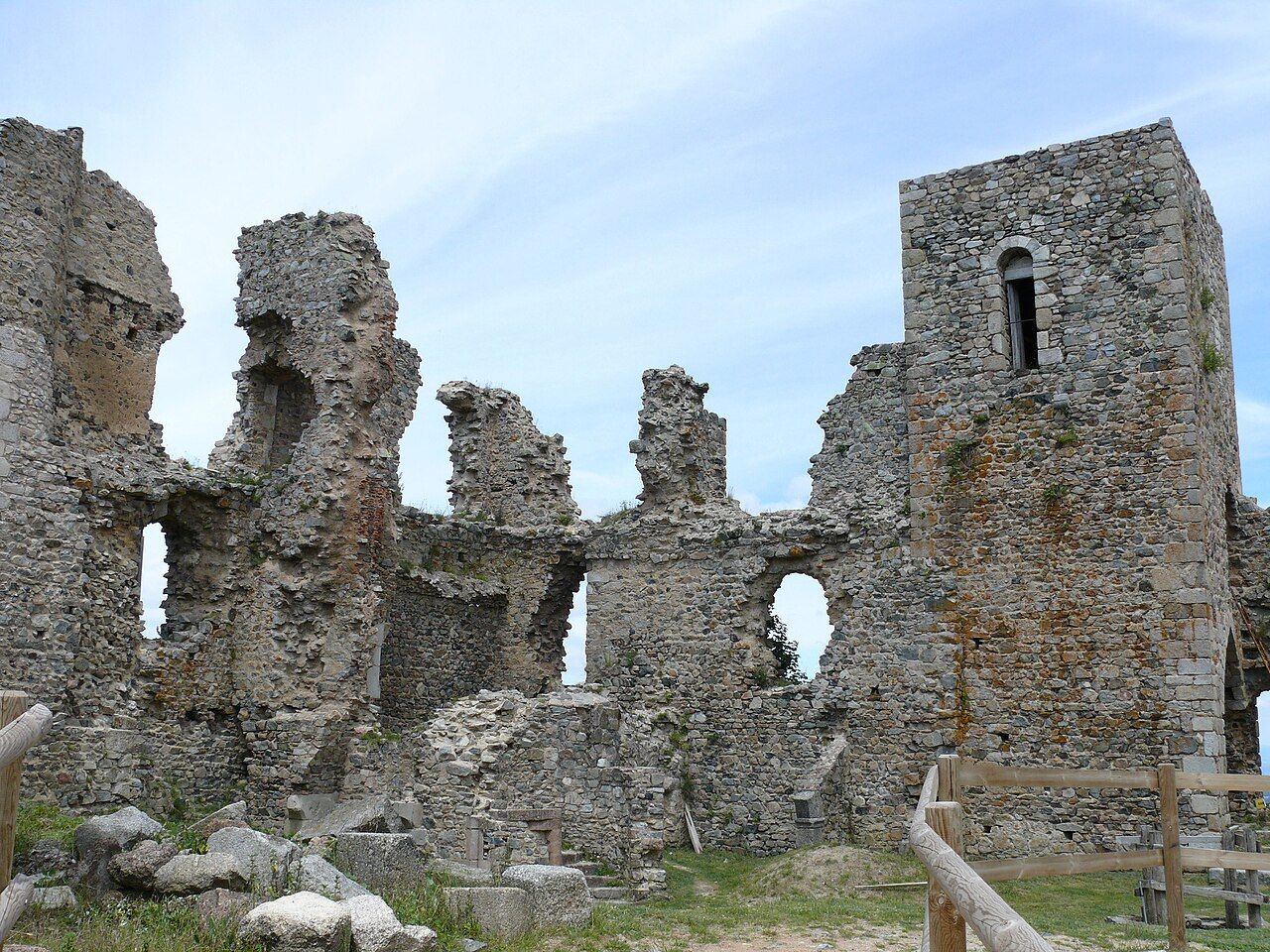
Within the walls you move between the remains of the courtyard and the shells of the residential buildings. Window openings frame the sky, and in places the thickness of the walls is easy to read in the cut faces of rubble and granite. Wooden fencing keeps visitors back from the more fragile sections, and it is worth respecting it: loose stones fall, and some of the drops are larger than they look.
Turn the page: Saint-Just-en-Chevalet, the village where roads meetThe view from the keep
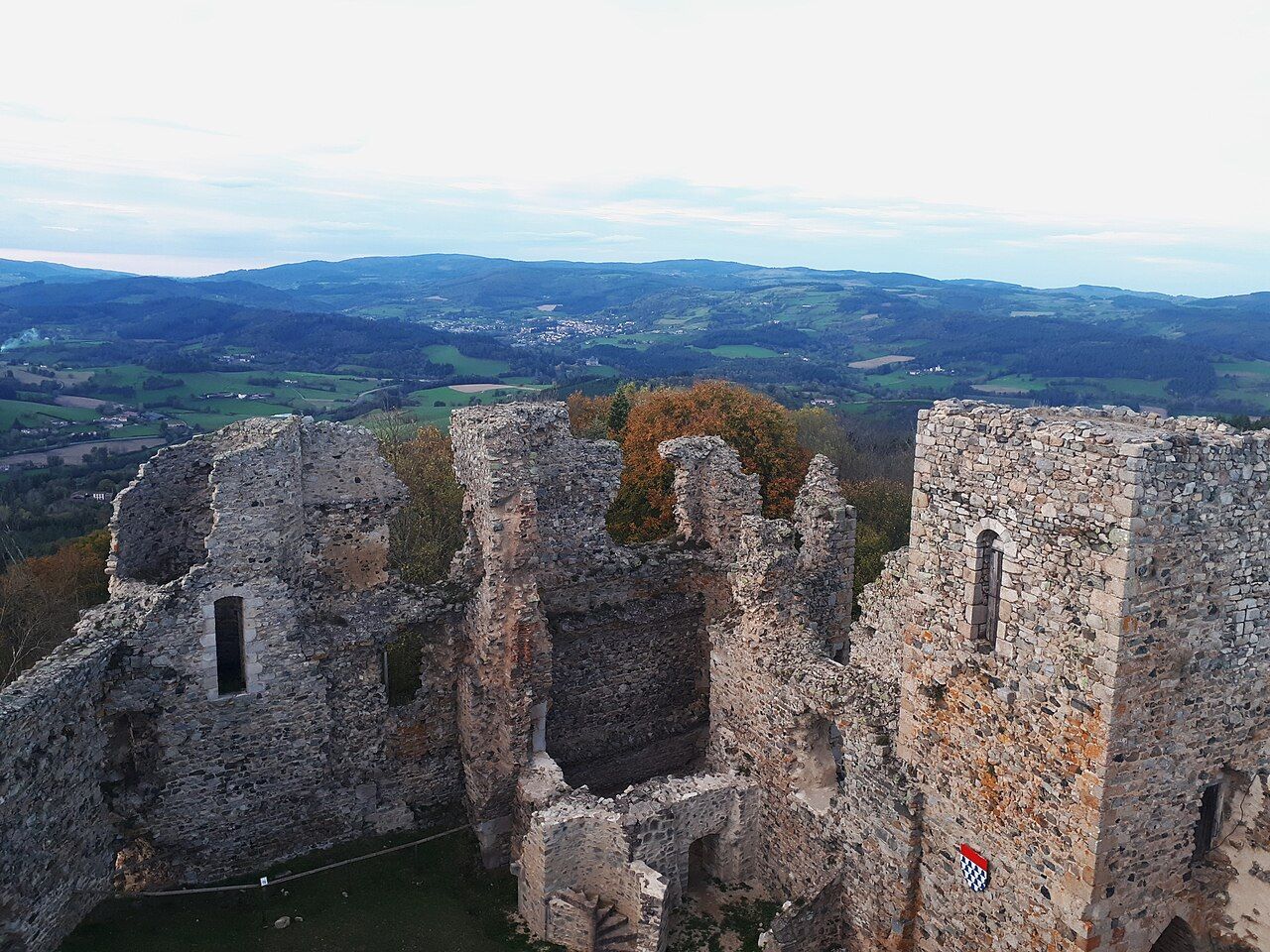
The round keep is the reason many people come back. From the top the ground falls away on every side, and the shape of the region becomes clear in a single turn. To the north the dark fir slopes of the Bois Noirs roll towards the borders of the Allier and the Puy-de-Dôme. To the south and east the land drops in stages towards the flat Forez plain, with the Monts du Lyonnais on the far side, while the Roannais opens to the north-east.
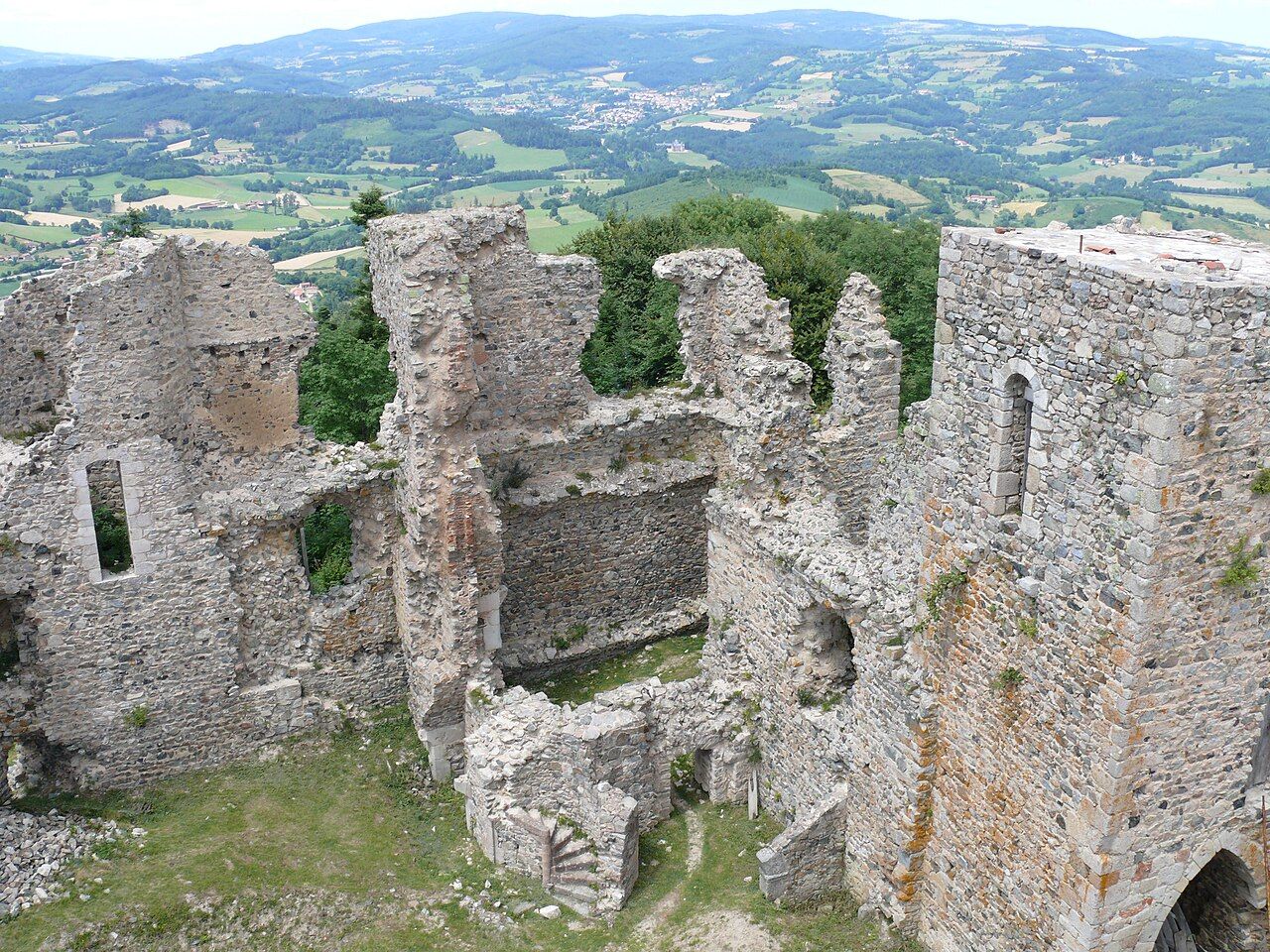
On days of very clear air, often in autumn or after a cold front, the horizon is said to stretch as far as the Alps. Haze is more common in summer, when the plain lies under a soft blue veil, but even then the patchwork of fields, hedges and woods below is worth the climb.
From above, the plan of the castle also makes more sense. You can see how the courtyard sat between the keep and the square tower, how the walls followed the edge of the rock, and why the site was chosen: anyone coming up from the valleys would have been seen long before they arrived.
When to go and what to expect
Late spring and early autumn are the most rewarding seasons. In May and June the meadows on the approach are full of flowers, and in October the beeches below the summit turn copper against the dark firs. Summer brings the most visitors, though "most" here is a relative word, and the hilltop is rarely crowded.
- Weather. The summit is exposed. Even on a warm day the wind can be cold, so carry an extra layer.
- Facilities. Expect none at the top: no water, no shelter and no toilets. Bring what you need.
- Access. The ruins are cared for by local volunteers and the commune.
- Children and dogs. Keep a close eye on both near the walls and on the keep, where railings and stairs are narrow.
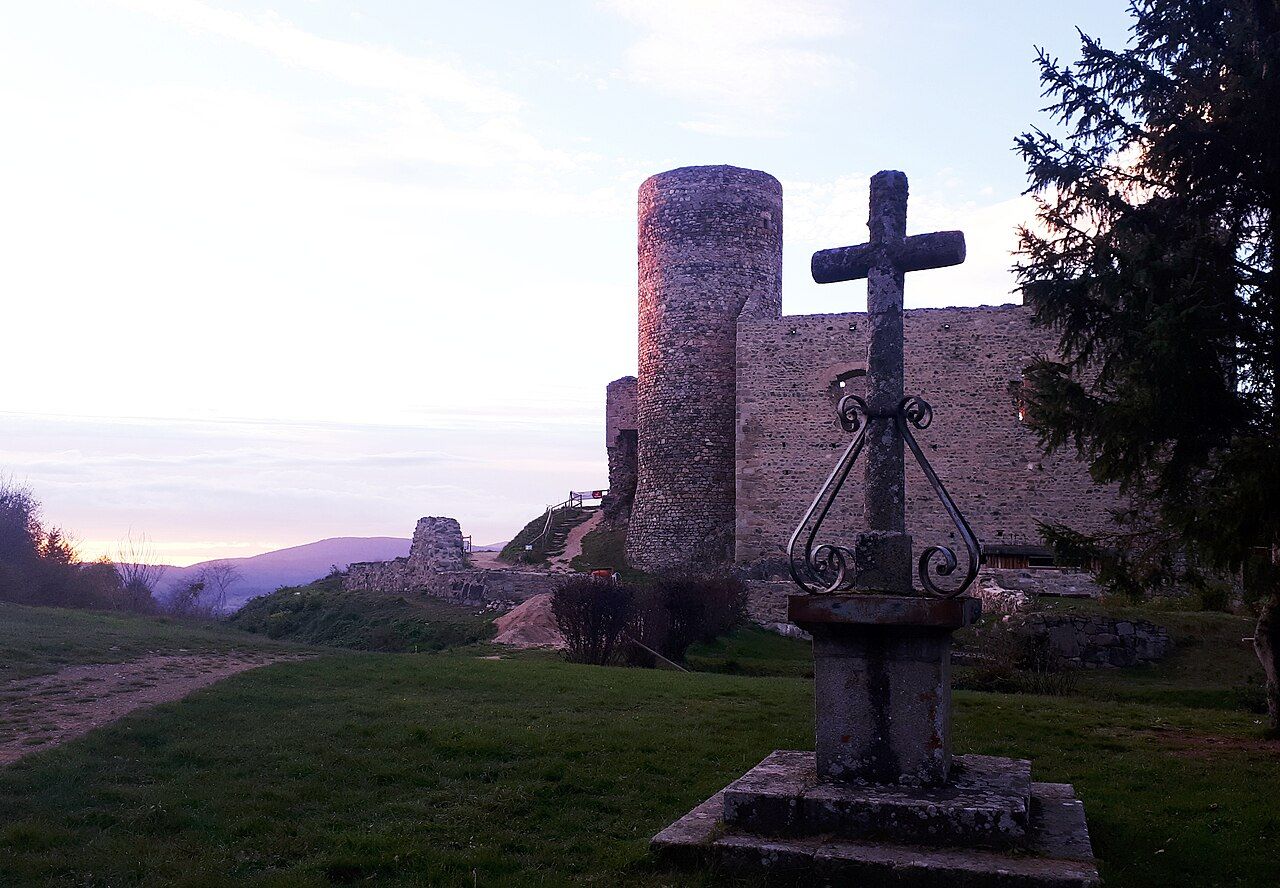
Late in the day the light turns warm on the stone, and a wayside cross on its granite base stands in front of the walls like a sentry. Sunset visits are popular in summer, but remember that the path back to the parking area runs through trees and darkens quickly.
Combining the castle with the rest of the area
The Château d'Urfé sits at the heart of a circle of small villages, each a short drive away. Champoly lies directly below; Saint-Just-en-Chevalet, the main village of the area, is a little further on; and Saint-Romain-d'Urfé carries the family name on its signposts. A day can easily link the castle with a walk in the forests to the north or a drive down to the plain to see the family's later home.
Seeing both houses gives the clearest picture of the Urfé story. Up here is the medieval fortress, built for defence and for watching over the valleys. Down in the plain is the Renaissance residence, built for comfort, learning and display. Between the two lies the river Lignon, where Honoré d'Urfé set his shepherds and shepherdesses, and it is the hill with the two towers that ties all three together.