
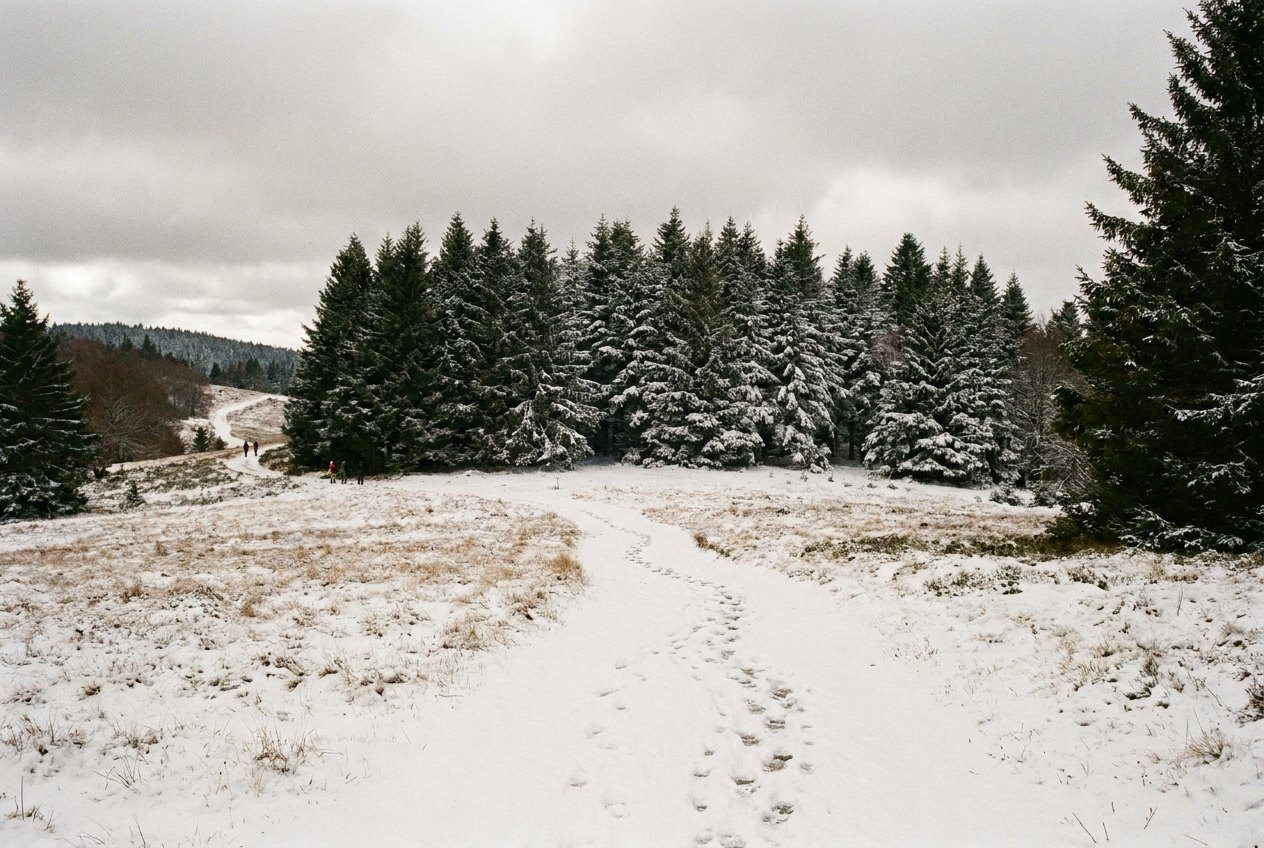
The Pays d'Urfé is not a ski resort, and that is exactly what makes a snow day here special. There are no lift queues or crowded slopes, just fir forests, quiet ridges and village lanes transformed for a few days or weeks. Snow cover varies a great deal from one winter to the next and from one valley to the next, so treat each good fall as an opportunity rather than something to plan around months ahead.
When and where the snow falls
The Monts de la Madeleine and the Bois Noirs rise to well over 1,000 m on their highest ground, high enough to catch snow when Atlantic or northern weather systems bring cold air across central France. The valley floors and the villages on lower slopes may only see a dusting that melts within a day, while the forests above stay white much longer.
The best conditions usually come between December and March, but timing is unpredictable. A mild spell can wipe out a fine snowpack in a few days, and a late cold snap can bring snow in spring.
Where to look
- The high forests around Saint-Priest-la-Prugne, the highest village of the area, where snow tends to lie longest.
- The fir woods and clearings of the Bois Noirs, ideal for snowshoeing.
- Open slopes near hill villages, often used informally by local families for sledging.
Snowshoeing in the fir forests
Snowshoes, called raquettes in French, are the best way to explore the hills in deep snow. They spread your weight so you float rather than sink, and they need no special skill beyond a slightly wider stride. Forestry tracks and waymarked walking circuits make natural routes, as they are broad and easy to follow even when covered.
Waymarks can disappear under snow or frost on the trees, so navigation needs more care than in summer. Carry a map and compass or a reliable navigation device, and know how to use them. Our guide to the waymarked walks explains the summer markings, which still help when you can spot them.
Distances feel longer in snow. A route that takes two hours in summer can take twice as long on snowshoes, especially if you are breaking trail in fresh powder. Daylight is short in midwinter, so start early and turn back with plenty of time to spare. Poles help with balance and make climbing easier.
Sledging with children
Turn the page: The towers of Urfé on their hillSledging needs no equipment beyond a sledge and warm clothes, and gentle open slopes near the villages are often enough for children. Choose a slope with a long, flat run-out, away from roads, fences, streams and trees. Check the ground under the snow if you can: rocks and stumps hidden just below the surface can cause injuries.
Fields are usually private and may be used for grazing or hay, so stick to places where sledging is clearly accepted, and ask if in doubt. Never sledge onto roads or forest tracks, where vehicles may be moving even on snowy days.
Driving on winter roads
Hill roads in the Pays d'Urfé are narrow, winding and often steep, and some climb to well over 1,000 m. Snow and ice can make them difficult or dangerous, especially in the shaded forest sections where ice lingers long after the open slopes have cleared. Main routes are generally cleared first, while minor roads may stay snowy for some time.
France has rules requiring winter equipment, either winter tyres or chains or socks carried in the vehicle, in designated mountain areas during the winter months. Which communes are covered and what exactly is required can change. Practise fitting chains at home rather than learning on a cold roadside.
- Fill the tank before heading into the hills.
- Carry a blanket, water, food, a torch and a shovel.
- Allow extra time and drive gently, especially downhill.
- If a road looks too risky, turn back and choose another day.
Staying safe in the cold
Temperatures on the summits are often several degrees lower than in the valleys, and wind adds a real chill. Dress in layers you can add or remove, keep a dry spare layer in your pack and protect your hands, feet and head. A thermos of hot drink makes a big difference to morale on a long outing.
Fog can roll in quickly on the high ground, cutting visibility to a few metres. If that happens, stay on known tracks and retrace your steps if necessary. Phone signal can be weak in the forest, so tell someone your route and expected return time.
Respect wildlife too. Winter is a hard season for deer and birds, and disturbing them forces them to use precious energy. Keep dogs under control and avoid going off track through dense cover.
Further afield
For more reliable snow and organised cross-country skiing, look south to the Monts du Forez, beyond Noirétable, where higher ground holds the snow longer. The Col de la Loge, in that range, is known for Nordic skiing and snowshoe routes when conditions allow. Our page on Noirétable and the Forez hills covers that higher country. Facilities and opening depend entirely on snow cover.
Closer to home, a snowy morning on the castle hill or in the fir woods can be just as rewarding. When the hills are quiet and the snow is fresh, the Pays d'Urfé shows a calm, almost Nordic face that few visitors ever see.