
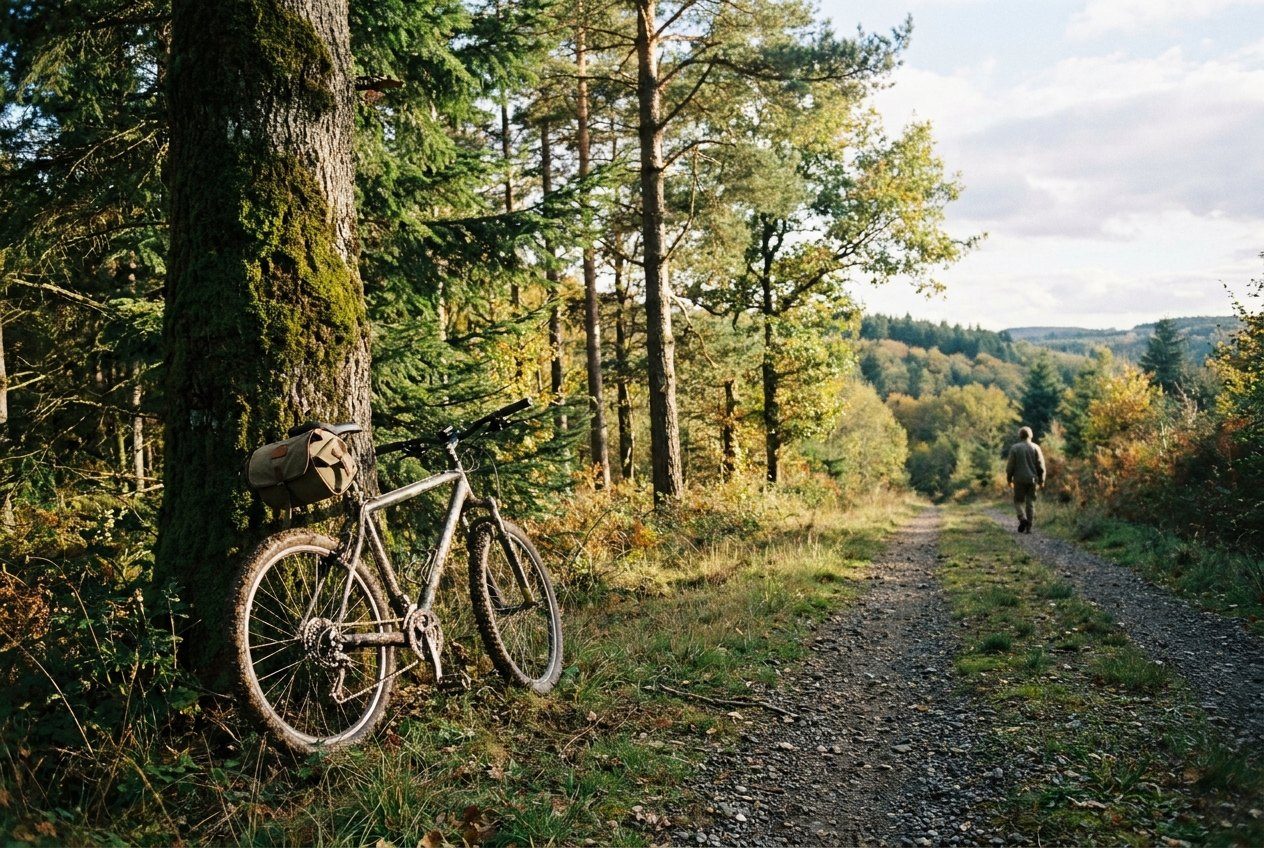
The same qualities that make the Pays d'Urfé good walking country also make it good for mountain biking. Long forestry roads cut across the slopes, older lanes drop between hedges and stone walls, and the ridges between valleys offer stretches of fast, rolling track. The French call the sport VTT, short for vélo tout terrain, and you will see those letters on signposts and in local leaflets.
What the terrain is like
The hills are built on granite and similar old rocks, which break down into a coarse, sandy gravel. When dry, it gives good grip and drains fast; after rain, the surface can become loose on steep descents, and roots and wet leaves under the fir trees turn slick. Height differences are significant. Valley floors sit at a few hundred metres, while the high forests of the Bois Noirs and the Monts de la Madeleine climb above 1,000 m, so almost any ride includes sustained climbs.
The landscape changes with altitude. Lower down you ride through a patchwork of pasture, hedges and small woods, passing granite farms and hamlets. Higher up, conifer plantations and older mixed forest take over, with long straight forestry roads that are easy to follow and good for building fitness. Open ridges between the two give the views.
Signed circuits and route planning
Some communes and local bodies have marked VTT circuits, often with numbered posts and colour codes that indicate difficulty. The colours used for ski slopes are common in France: green for easy, blue for moderate, red for hard and black for very hard.
Many riders simply build their own loops from forestry tracks and quiet roads. A 1:25,000 map shows track types and contour lines, which matter more than distance here: a short ride with several steep climbs can take as long as a much longer, flatter one. A navigation device or phone app helps, but signal and battery both fade in cold, deep forest, so keep a paper back-up.
Ideas for a first ride
- A valley loop on lanes and farm tracks, with one climb to a viewpoint, to get used to the surfaces.
- A forest ride on the wide tracks of the Bois Noirs, where gradients are steadier and navigation is simple.
- A longer day linking two villages over a ridge, with lunch carried in your pack.
Climbing and descending
Expect to spend time in your lowest gears. Some lanes are steep enough to make even strong riders walk short sections, especially where the surface is loose. Pace yourself on the first climb of the day and remember that every descent is followed by another ascent.
Descents demand attention. Visibility is often limited on wooded bends, and you may meet walkers, horses, tractors or logging lorries coming up. Ride at a speed that lets you stop within the distance you can see, and slow right down on gravel where fallen branches or ruts may hide. Forestry work can temporarily close tracks; obey any signs and barriers, as felling zones are genuinely dangerous.
Sharing tracks with walkers
Turn the page: When the hills turn white: sledging and snowshoesMost VTT routes overlap with walking circuits, and on narrow paths walkers have priority. A bell or a friendly call well before you reach them avoids surprises, and passing at walking pace costs you only a few seconds. Our guide to the waymarked walks explains the yellow marks you will see on shared sections.
Stay on existing tracks rather than cutting new lines, especially in wet weather when tyres can tear up soft ground. Peat bogs and spring-fed meadows in the high forests are fragile habitats; ride round them, never across. Close gates behind you and give livestock a wide berth.
Hunting season
From autumn through winter, hunting is a significant activity in these hills, and organised drives for wild boar and deer often take place in the forests. Days and practices vary from commune to commune, and the details are set locally each season, so ask at the town hall or check notices in the village. Signs at the edge of the woods often indicate when a hunt is in progress; if you see one, choose another route.
Wear bright colours, keep to established tracks and avoid riding at dawn and dusk, when animals move and hunters may be waiting at their posts. A ride on the open ridges or along quiet roads can be a better choice on busy hunting days. In autumn, also expect mushroom pickers in the woods, a theme covered in our autumn guide.
Practical preparation
Services are thin in the hills. Carry a spare tube, a pump, tyre levers and a multi-tool, along with enough food and water for the whole ride, since villages are spread out and you cannot count on finding anywhere open. Weather changes faster on the heights than in the valleys: low cloud, wind and rain can arrive within an hour, and temperatures on the summits are noticeably lower. A light waterproof layer is worth its weight.
Tell someone your planned route and expected return time, especially if you ride alone in the forest. Bike rental, guided rides and repair services exist in the wider region, but arrangements change.
When to ride
Late spring and early autumn usually offer the best balance of dry tracks, mild temperatures and long days. Midsummer can be hot in the valleys, though the forests stay cooler. Winter riding is possible on lower routes when there is no snow, but the high forests may hold ice and snow for weeks; if white weather is what you are after, swap the bike for snowshoes. Early mornings in the area around Saint-Priest-la-Prugne can be cold even in June, so pack an extra layer for the first hour.